A Smarter Foundation for Designing Work That Enables Thriving
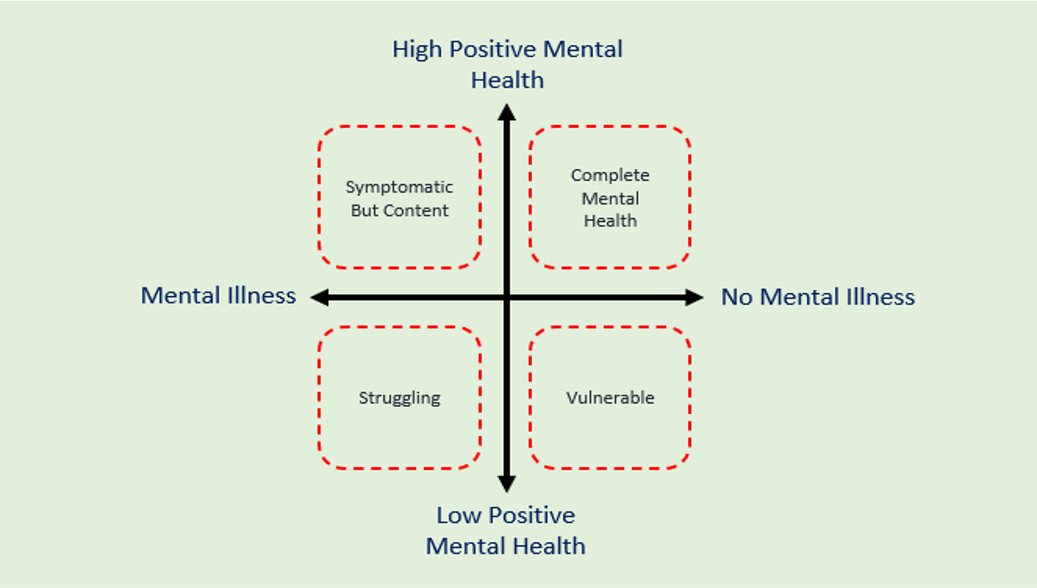
Traditional approaches to mental health in organizations often rely on a single continuum, where mental health and mental illness are treated as opposite ends of the same spectrum. ThriveOS moves beyond this limitation by adopting the Dual-Continua Model, providing a more accurate and actionable foundation for diagnosis and design.
Beyond the Traditional View
The Bipolar Model (Traditional Approach)
In conventional models, mental health and mental illness are seen as opposites. Individuals are assumed to “move” along a single continuum, away from illness and toward health.
This approach is overly simplistic and limits how organizations understand workforce realities.
The Dual-Continua Model (ThriveOS Approach)
The Dual-Continua Model recognizes that:
⇒ Mental health and mental illness are two distinct but related dimensions;
⇒ High well-being does not automatically mean absence of mental illness;
⇒ Individuals can experience both flourishing and struggle simultaneously;
This perspective reflects the real complexity of human experience at work and creates a stronger foundation for meaningful intervention.
Tip1
Independent Measurement
Mental health and mental illness can be assessed separately, allowing for more precise and reliable diagnostics.
Tip2
More Accurate Workforce Segmentation
Organizations can identify groups that traditional models overlook, such as:
⇒ employees who are functioning but struggling
⇒employees who are not distressed but disengaged
Tip3
Safe and Flexible Disclosure
Individuals can share information about well-being without necessarily disclosing sensitive mental illness data, improving participation and data quality.
Tip4
Enabling Proactive Design
The model opens the door to preventive, design-driven interventions, rather than reactive responses to visible problems.
From Measurement to Meaningful Design
The Role of the Dual-Continua Model in ThriveOS Design
Within ThriveOS, the Dual-Continua Model plays a critical role in post-assessment intervention design, especially in the Design phase.
→ Failing to measure both dimensions leads to:
⇒ incomplete understanding of root causes
⇒ weak explanatory power of outcomes
⇒ inability to identify key at-risk groups
→ By contrast, applying the Dual-Continua lens enables:
⇒Clear identification of “who needs what”
⇒ More targeted and differentiated interventions
⇒ Better alignment between work design and human needs
Designing Work for Different Realities
The real power of the Dual-Continua Model lies in its ability to inform work design decisions.
Instead of applying one-size-fits-all solutions, organizations can design work based on different workforce profiles:
⇒ Supporting high performers who are silently struggling
⇒Re-engaging individuals with low motivation but no clinical distress
⇒ Strengthening resilience in already thriving teams
👉 This allows interventions to be embedded directly into work structures, not treated as external fixes.
Scaling Impact Beyond the Individual
The implications extend beyond individual interventions:
⇒Teams: better alignment of collaboration, workload, and safety
⇒ Organizations: smarter prioritization of design investments
⇒ Policy & Systems: targeted, evidence-based decision-making at scale
A Foundation for Intelligent Work Design
The Dual-Continua Model provides the clarity needed to move from:
→ generic well-being initiatives
⇒ to precision-designed work systems
→ reactive problem-solving
⇒ to proactive capability building
→ fragmented interventions
⇒ to integrated, system-level design
**In ThriveOS, understanding well-being is not the end goal,
it is the starting point for redesigning work to enable true organizational thriving.**