
The Work Structure Assessment is a core diagnostic module within ThriveOS that examines the underlying work conditions shaping employee thriving or strain.
While the Thriving State Assessment focuses on how employees are currently functioning, the Work Structure Assessment explains why these states emerge by analyzing job design, work context, and organizational conditions.
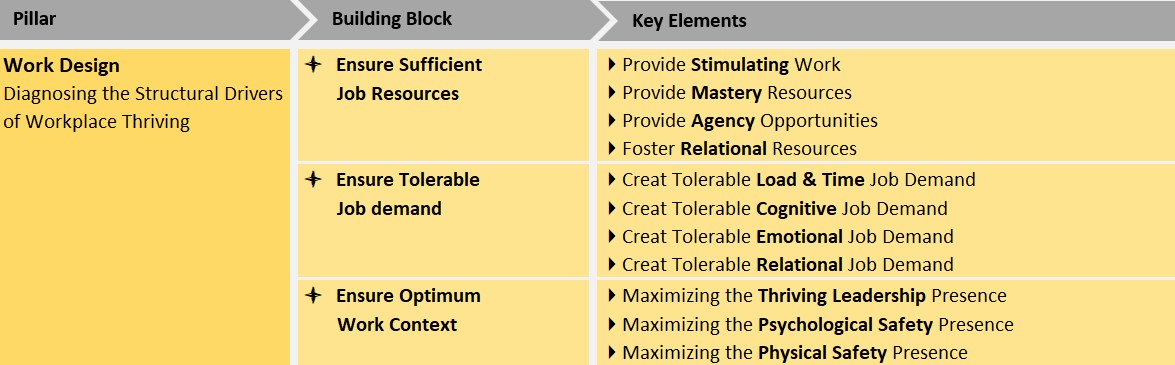
The Work Structure Assessment operates to identify and reduce psychosocial risks in the workplace through three interconnected building blocks:
💡 ensuring sufficient job resources
⚖️ maintaining tolerable job demands
🏢 ensuring optimum work context
Together, these dimensions reveal the structural “DNA” of work that influences employee well-being, performance, and thriving potential.
This reflects the principle that, unlike many physical hazards, psychosocial risks are present across all jobs and industries, making the protection of mental health a universal organizational responsibility embedded in modern workplace practice and regulation.
Research consistently finds that factors associated with work and the work environment can significantly increase the likelihood of employees developing physical and mental health conditions, including musculoskeletal conditions, depression, anxiety, and substance abuse.
The key to reducing the effects of work-related stress is to understand and control for the types of organisational stressors or risk factors that might lead workers to experience stress and sustain psychological and/or physical ill-health. Common organisational stressors include:
⇒ Low or high work demands;
⇒ Low control;
⇒ Low task variety;
⇒ Low task significance;
⇒ Poor support;
⇒ Lack of role clarity;
⇒ Poorly managed relationships;
⇒ Low levels of recognition and reward;
⇒ Poorly managed change; and
⇒ Organisational injustice.
The mental health outcomes associated with uncontrolled risk factors contribute to decreases in organisational performance. Outcomes include:
⇒ Increased absenteeism rates;
⇒ Reduced productivity and performance;
⇒ Higher turnover rates and associated costs; and
⇒ Increased workers compensation rates attributable to work stress.
The building blocks in the Work Structure assessment pillar enable organisations to take proactive, preventative measures to either reduce or remove risk factors, and thereby reduce the potential for harm.

36% of people working in a workplace they consider mentally unhealthy have taken time off from work in the past 12 months because they felt stressed, anxious, depressed or mentally unhealthy.
This section examines whether employees have access to the resources needed to grow, perform, and remain engaged at work.
Job resources are aspects of work that help people to meet their work goals and, as such, are positive for workers’ mental health. Job resources can also buffer the damaging effects of high job demands, thereby making the demands less stressful.
Increasing job resources is a type of work redesign. Work redesign means changing employees’ tasks, responsibilities, and interactions with people within their job. Good work design that balances an employee’s job resources and demands addresses organisational stressors and therefore protects against psychological harm.
The SMART Work Design model, is a useful model that employees and employers can refer to when designing meaningful and motivating work. Based on decades of research, the SMART Work Design model identifies five key job characteristics that result in positive outcomes across jobs and industries. The characteristics for SMART work are: Stimulating, Mastery, Agency, Relational, and Tolerable demands.

There are many job resources that can be considered. The SMART work design model identities four key types of job resources:
⇒ Stimulating job resources – stimulating job resources include having task variety and meaning in the job;
⇒ Mastery job resources – mastery job resources include workers having role clarity, and receiving feedback, including getting appropriate reward and recognition in their work;
⇒ Agency job resources – agency job resources include job control and participation in decision-making; and
⇒ Relational job resources – relational job resources are about having positive work relationships and having high levels of supervisor and co-worker support.
Tolerable demands are addressed within the Ensure Tolerable Job Demands building block.
This section evaluates whether work demands are manageable and sustainable over time. It focuses on preventing overload while maintaining productivity.
Job demands are aspects of work that require effort. In excess, or when there are insufficient buffering job resources, job demands can cause stress and discomfort. Organisations can actively demonstrate their legal compliance through work design that removes, reduces, or manages excessive and harmful job demands in the workplace.
In the SMART model of work design, the T stands for “Tolerable” demands. This recognises that every individual has different levels of tolerance to demands in the workplace, and stress can occur when the amount of work demands exceeds a person’s capacity to cope. Therefore, when evaluating the level of demands, it is important to take into account not only the demands but the person.

There are a number of job demands that organisations should manage to ensure they are tolerable. These can include:
⇒ Time demands – inadequate time or resources available to complete allocated work, or long working hours;
⇒ Cognitive demands – tasks that are mentally demanding due to long periods of high concentration and difficult decision making, or are boring and repetitive;
⇒ Emotional demands – work that is emotionally challenging, due to high emotional involvement, or having to regularly disguise emotion at work;
⇒ Physical demands – tasks or a physical environment at work that negatively impacts health;
⇒ Demands associated with organisational change – poor consultation, communication and implementation of change; and
⇒ Demands caused by a lack of organisational justice – processes, procedures, decisions and interactions that lack transparency and are inconsistently handled.
Research indicates that individuals reporting high levels of job demands are 30-35% more likely to develop mental ill-health.
This section captures the broader organizational environment in which work takes place, creating the conditions where people can sustainably thrive.
It reflects leadership, safety, and psychological conditions that shape employee experience.
Even when job resources are sufficient and job demands are well-managed, a poorly designed work context can still lead to stress, disengagement, and burnout.
Work context includes leadership behaviors, team dynamics, communication patterns, and the overall sense of safety within the workplace. These factors directly influence whether employees feel supported, valued, and safe to contribute.
Research consistently shows that a high-quality work context is a strong predictor of psychological safety, engagement, performance, and retention.
An ineffective work context can undermine even the best job design efforts.
Key Building Blocks of Optimum Work Context:
1. Maximizing the Thriving Leadership Presence
Leadership plays a critical role in shaping the work experience. Thriving leaders:
⇒ Regularly check in with employees and show genuine care
⇒ Create safe spaces to discuss stress, workload, and challenges
⇒ Act on feedback transparently and communicate clearly
⇒ Recognize and celebrate contributions in a fair and meaningful way
Such leadership builds trust, strengthens engagement, and enhances overall wellbeing.
2. Maximizing the Psychological Safety Presence
Psychological safety refers to an environment where employees feel safe to speak up, share ideas, and make mistakes without fear of negative consequences.
Organizations can strengthen this by:
⇒ Creating safe and accessible feedback channels
⇒ Running inclusive and respectful team discussions
⇒ Reducing power distance and encouraging participation
⇒ Promoting open, honest, and consistent communication
When psychological safety is high, learning, innovation, and collaboration significantly improve.
3. Maximizing the Physical Safety Presence
Physical safety remains a foundational element of a healthy work environment and is closely linked to mental wellbeing. This includes:
⇒ Providing a safe and healthy physical workspace
⇒ Managing fatigue and ensuring adequate breaks
⇒ Preventing excessive workload and overload
⇒ Enabling flexible work arrangements where possible
A physically safe environment reduces stress and supports focus, energy, and performance.
A strong work context acts as the foundation for all other workplace practices. Without it, even well-designed roles and resources will have limited impact on employee wellbeing and performance.

The full Work Structure Assessment, featuring its tools, modules, and evaluation components is provided in the dedicated Work Structure section.

At ThriveOS Academy, we offer structured training programs centered on the Work Structure module, with a focus on its assessment framework and practical intervention strategies, leading to certification upon completion.

The Certified ThriveOS Consultant Network brings together professionals who are trained through the ThriveOS Academy. They are equipped to turn Work Structure insights into practical interventions that help organizations thrive.

Explore how Work Structure turns workforce data into an intelligence architecture for interpreting organisational patterns and outcomes.